
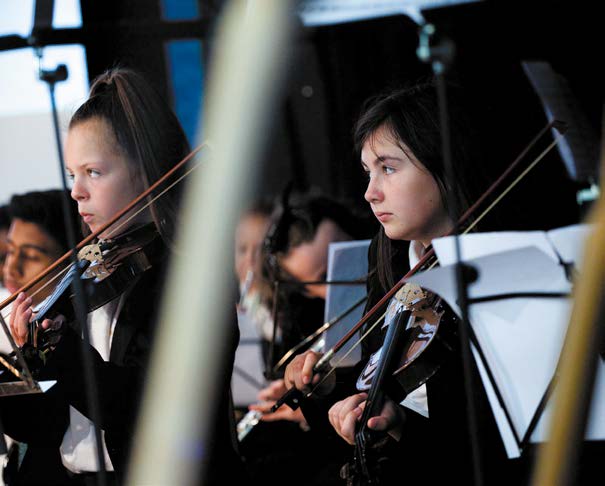
 Music is constantly evolving, inspiring creativity and expression in a way that no other subject can. At Trinity Catholic College the curriculum is designed to appeal to, and cater for, a wide range of interests, instruments, personalities and directions. Learners have the opportunity to explore instruments and music from a range of historical periods, genres, styles and traditions.
Our Music Development Plan can be found here.
KEY STAGE 3
YEAR 7
Topics
- Term 1 Folk Music
Students will develop their knowledge and understanding of folk music as a musical genre. This unit also develops students’ ability to analyse, create and perform their own musical arrangements of traditional folk songs.
They listen to examples of folk music from different times and different places and compare the use of instruments, musical elements and compositional devices used.
Students will perform as part of small ensembles and arrange their own folk songs using features they have learned from the unit.
- Term 2 Pop Music
Students will develop their knowledge and understanding of pop music as a musical genre. This unit also develops students’ ability to analyse, create and perform their own musical arrangements of popular songs.
They listen to examples of pop music from different times and compare the use of instruments, musical elements and compositional devices used.
Students will perform as part of small ensembles and arrange their own cover versions and mash-ups of songs using features they have learned from the unit.
- Term 3 Classical Music
Students will develop their knowledge and understanding of orchestral music using examples from the BBC’s Ten Pieces initiative.
This unit also develops students’ ability to analyse, create and perform their own musical arrangements of classical repertoire. They listen to examples of orchestral music from different times and compare the use of instruments, musical elements and compositional devices used.
Students will perform as part of small ensembles and arrange their own musical arrangement of an orchestral piece they have learned from the unit
YEAR 8
-
Term 1 TV Themes
Students will develop their knowledge and understanding of TV themes as a musical genre.
This unit also develops students’ ability to analyse, create and perform their own TV theme compositions. They listen to examples of TV themes and compare the use of instruments, musical elements and compositional devices used.
Students will perform as part of small ensembles and compose their own TV theme using features they have learned from the unit.
- Term 2 African Drumming
Students will explore the main rhythmic musical features and devices used in African music, particularly the drumming tradition of West Africa.
Students learn to perform different drum strokes on djembe before composing, performing and improvising simple rhythms, turning these into cyclic rhythms.
These are then combined to form a polyrhythmic texture, characteristic of much African music. Students explore the effect of syncopation on rhythms learning about its offbeat feel and its emphasis on weaker beats before exploring how call and response is used in African music, improvising, composing and performing their own call and response rhythms.
- Term 3 Reggae
This unit explores reggae music and the culture it comes from. Students learn about the importance of bass lines in reggae music and how offbeat chords are a key feature of music of this genre.
Students explore the strong and weak beats of the bar, syncopation and the effect that this has on reggae music, before looking at how “fragmented” melodic parts can be used as bassline riffs and melodic hooks.
Students explore the different textural layers which make up reggae music
YEAR 9
- Term 1 Film Music
Students compose their own soundtrack to a new film trailer learning how film composers use cue sheets to create music to fit with exact timings. Students perform famous themes exploring how film music composers use instruments to create a sense of time and place. Finally, students explore how composers use discords, instrumentation and extremes of pitch to create their own soundtrack using a storyboard to help them with their planning.
- Term 2 Samba
This unit introduces the polyrhythmic style of Latin-American Samba and identifies its roots in African and Spanish/Portuguese music. Through performing Samba, students will learn the sounds and understand the roles of each instrument used in Samba, learn about rhythmic loops, polyrhythms, call and response and improvisation in Samba and experience the exhilaration and physical impact of percussion ensemble music. Student will create their own group Samba compositions.
- Term 3 Songwriting
This unit introduces students to songwriting in popular music and its development since the 1950’s. Students learn about the origins of popular music and features which are characteristic of its style including bass lines,
chords and melodies. Students learn about the construction of triads and how these are formed from bass lines as a type of chord producing harmony. Students compose their own songs using features they have learned during the unit.
Assessment
To assess the student’s’ progress, we use audio and video recordings of student work. Students are given feedback throughout a project, they are assessed twice during a project and then formally assessed at the end of each project.
Homework
To help develop musical understanding, students are set homework tasks using Google Classroom. A contextual homework is set for each project. Students may also additionally be set homework tasks to complete and improve work for their current class project.
All of the work can be accessed by the students using Google Classroom from the College website.
Support
There is a range of additional resources available to support Music
- Additional Instrumental and Vocal lessons delivered in school through TVMS
- www.bbc.co.uk/education/subjects
- Various resources shared with Music students through Google Drive
Extra-Curricular
There is a choir, orchestra and various bands to help develop performance skills. There are many opportunities to perform for example whole school Mass, Town Hall Christmas Gala Concert, Christmas Liturgy, Easter Concert, Summer Show/Musical.
KEY STAGE 4
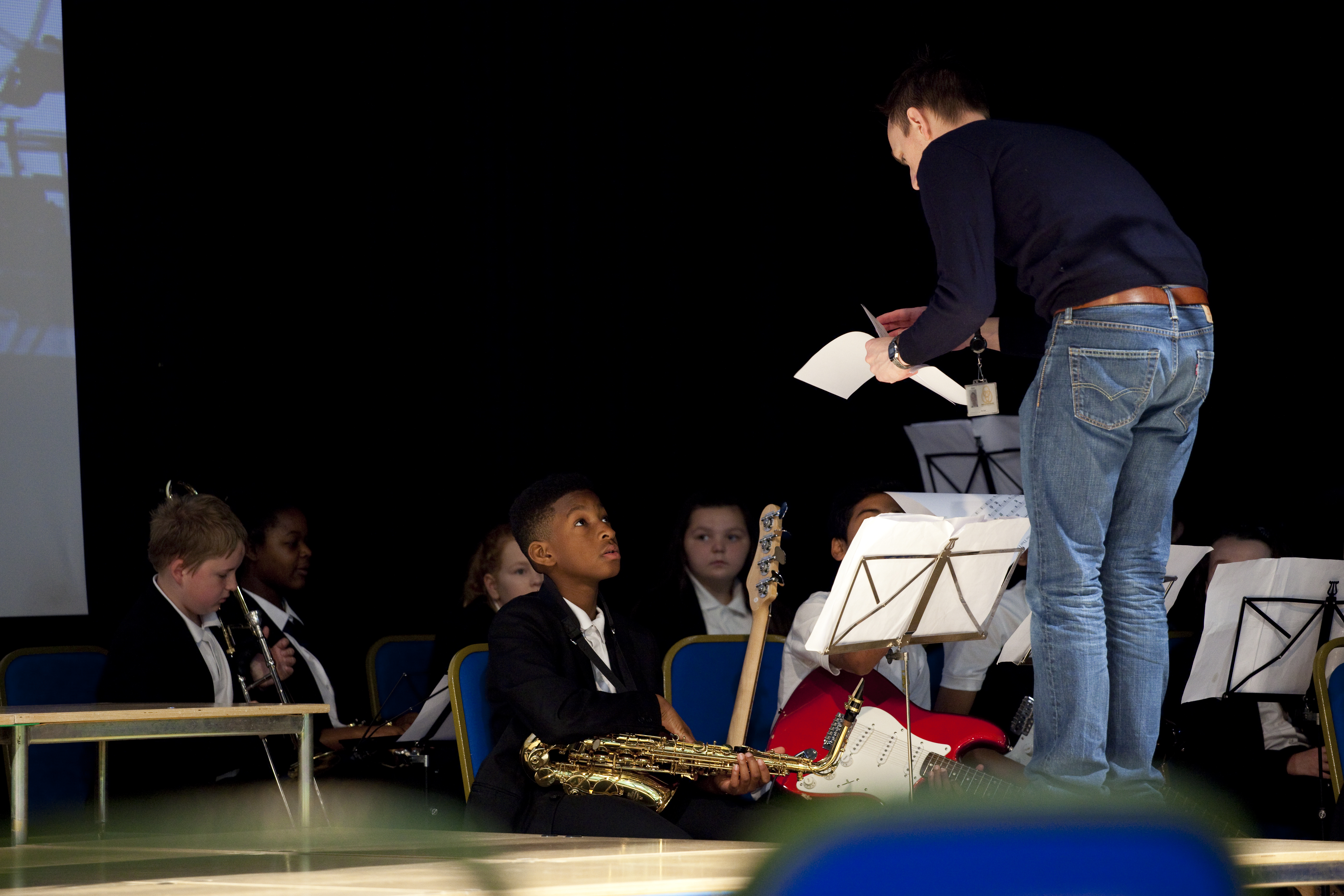 Music is constantly evolving, inspiring creativity and expression in a way that no other subject can. GCSE Music is designed to appeal to, and cater for, a wide range of interests, instruments, personalities and directions.
Learners will have the opportunity to explore instruments and areas of study depending on their personal preference and ability.
Topics
- Instrument study (voice or any other instrument). This can include sequencing using Garageband and Logic.
- Orchestral Music from 1650 to 1910. From the Baroque Solo Concerto to the Romantic Concerto.
- Traditional rhythmic roots from four geographical regions of the world including India and Punjab, Eastern Mediterranean and Middle East, Africa, and Central and South America.
- Music used for films including music that has been composed specifically for a film, music from the Western Classical tradition that has been used within a film and music that has been composed as a soundtrack for a video game.
- Popular music from the 1950s to the present day.
Assessment
Integrated Portfolio
- Performance on the learner’s chosen instrument or voice or Garageband and Logic work.
- Composition to a brief set by the learner.
- Non-exam assessment 30% of total GCSE
Practical Component
- Ensemble performance on the learner’s chosen instrument or voice or Garageband and Logic work..
- Composition to an exam board set brief.
- Non-exam assessment 30% of total GCSE
Listening and Appraising
- A written paper, with CD listening extracts. 1 hour and 30 minutes written paper 40% of total GCSE
Homework
Homework is an essential part of GCSE Music. Listening homeworks are set electronically and students should be practising their instrument regularly.
Support
There is a range of additional resources available to support Music GCSE
- Additional Instrumental and Vocal lessons delivered in school through TVMS
- www.bbc.co.uk/education/subjects – BBC bitesizse revision
- Various resources shared with Music GCSE students through Google Drive
Extra-Curricular
To support students with Music GCSE the department is available to use the resources every Tuesday, Wednesday and Thursday evening. There is a choir, orchestra and various bands to help develop performance skills
KEY STAGE 5
AQA AS Music
Unit 1 – Influences on Music
Unit 2 – Creating Musical Ideas
Unit 3 – Interpreting Musical Ideas
AQA A2 Music
Unit 4 – Music in Context
Unit 5 – Developing Musical Ideas
Unit 6 – A Musical Performance
Past papers and more information about the course can be found at: http://www.aqa.org.uk/subjects/music/a-level/music-2270
Pearson BTEC Level 3 Subsidiary Diploma in Music
Unit 23 – Music Performance Techniques
Unit 33 – Solo Music Performance Skills
Unit 7 – Composing Music
Unit 15 – Live Music Workshop
Unit 39 – The Sound and Music Industry
Unit 34 – Contemporary Songwriting Techniques
More information about the course can be found at: http://qualifications.pearson.com/en/qualifications/btec-nationals/music-2010.html
Extra-curricular
The Music department offers a wide variety of extra-curricular activities as a valuable extension of the curriculum. We recognise the singular contribution we can make towards the overall educational aims and objectives of the whole school. We provide a variety of social contexts in which pupils and staff can work together in offering the pupils opportunities to develop their interests and skills through performance.
We run a successful orchestra, vocal group, jazz band and theory class and are currently working hard on the forthcoming Trinity annual production.
Staff
Mr A Knox – Curriculum Team Leader


